SerenaI is a proactive stress companion built on one uncomfortable hypothesis: the best mental health tool is one that doesn't wait to be asked. It reads signals like sleep, calendar density, and messaging patterns, then intervenes before the user hits a wall. The design challenge wasn't the interface. It was the timing, the consent, and the question of whether removing a user's choice is ever the right call.
YEAR
2025
ROLE
UI/UX Designer
Creative Director
SERVICES
User Experience Design
User Interface Design
AI Integration
Mental Health Research
UI Animation
About the project
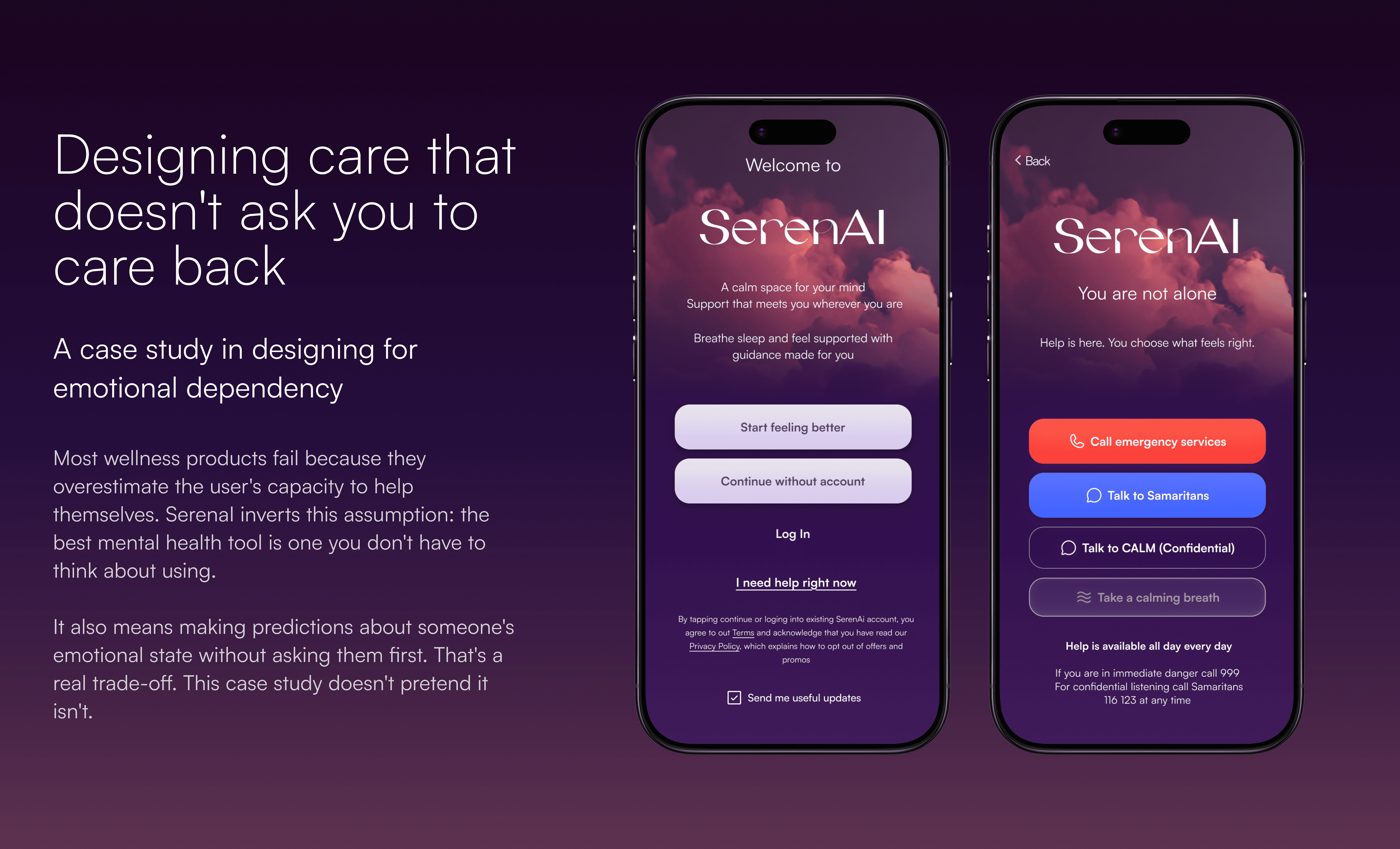
Built on one hypothesis. Complicated by what proved it true.
We conducted 14 interviews with high-stress professionals. But the insight didn't come from asking “How do you want to manage stress?”
The insight came from watching them not use the apps they'd downloaded.
The Uncomfortable Truth We Started With
Many wellness tools make people feel worse during stress. They add too many choices and track progress in ways that feel judgmental. Users shared that they want emotional support that is compassionate and easy to access. They do not want more pressure when they are already struggling.
When stress is invisible it grows quickly. People need something that notices when they are not okay and responds with care.
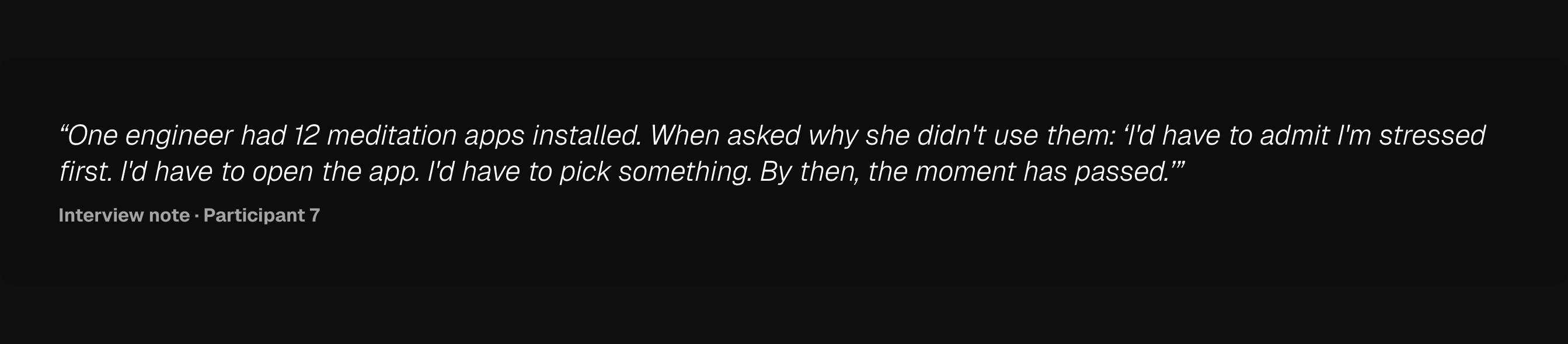
That sat with us for a while. Then someone in the debrief said it out loud:
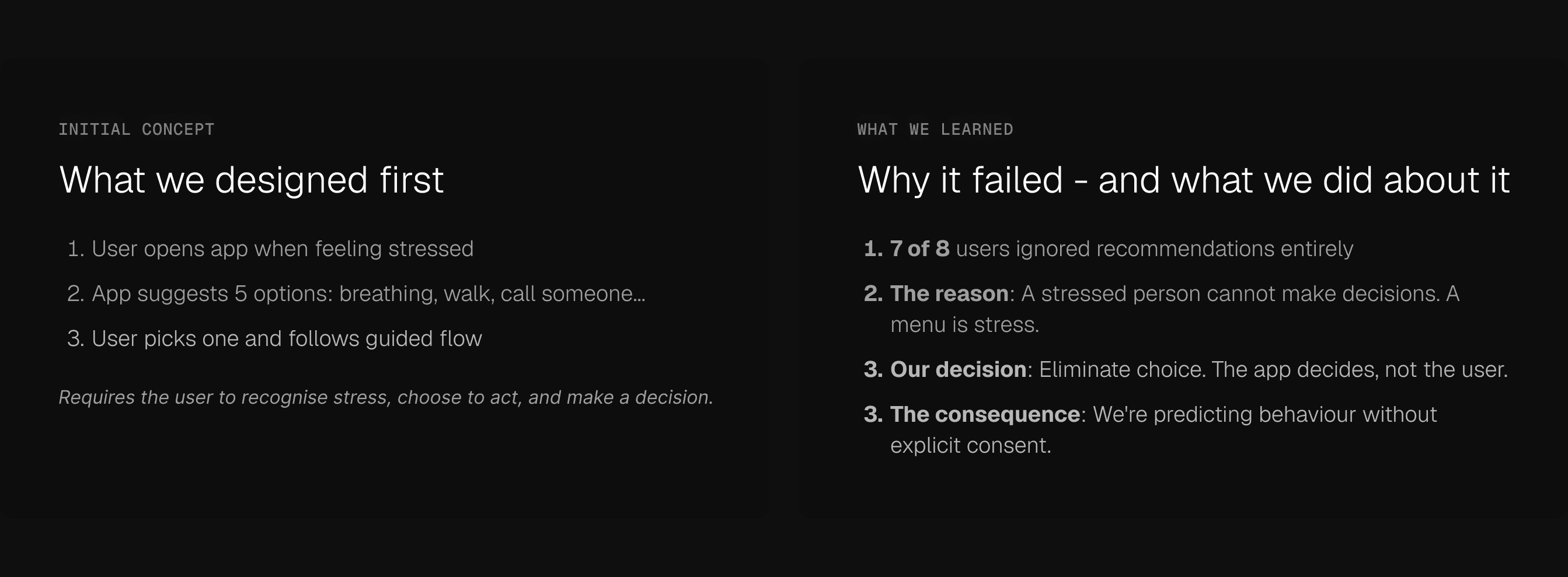
What if the best stress management tool is one that removes human agency?
Where We Got It Wrong First
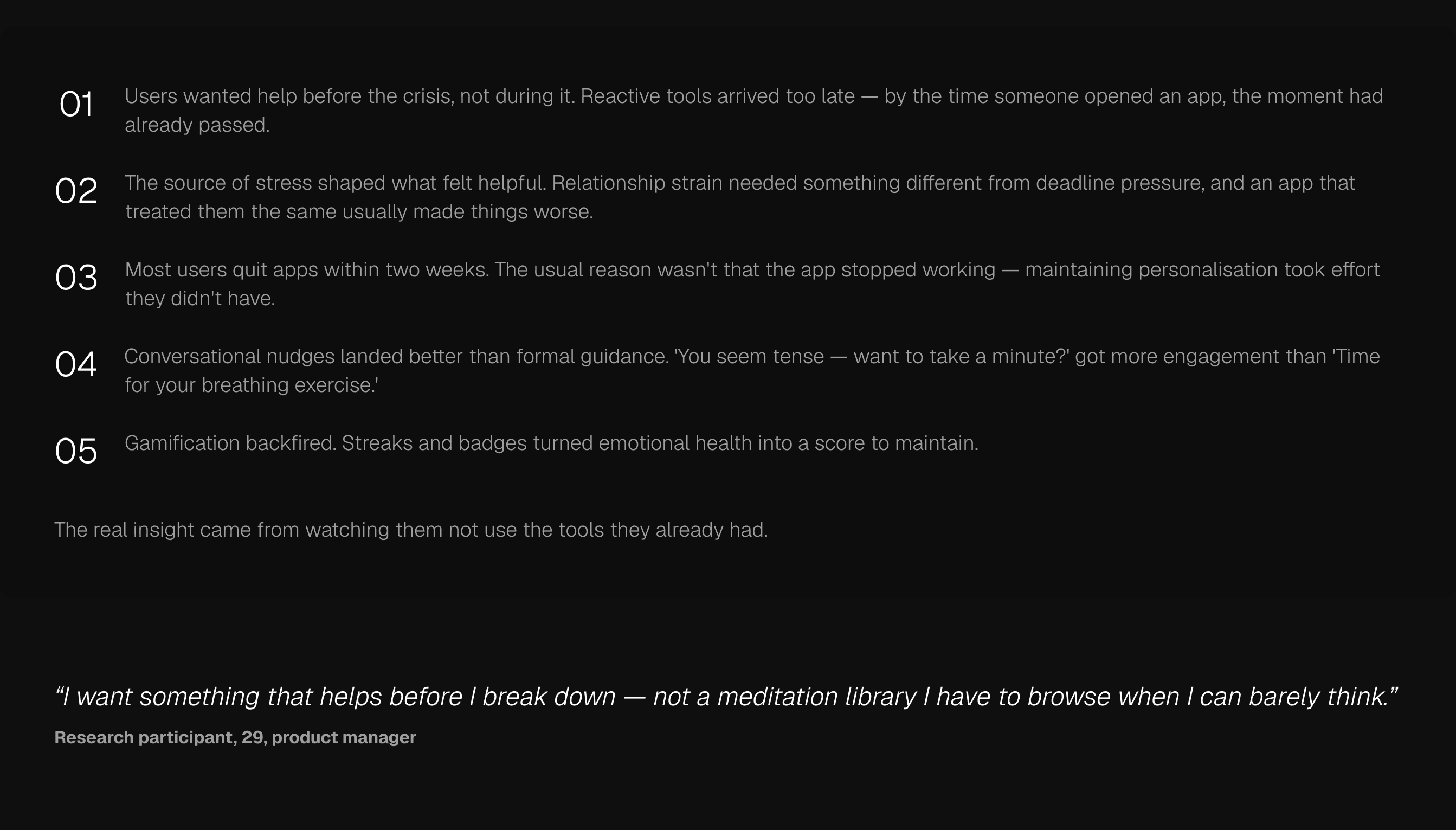
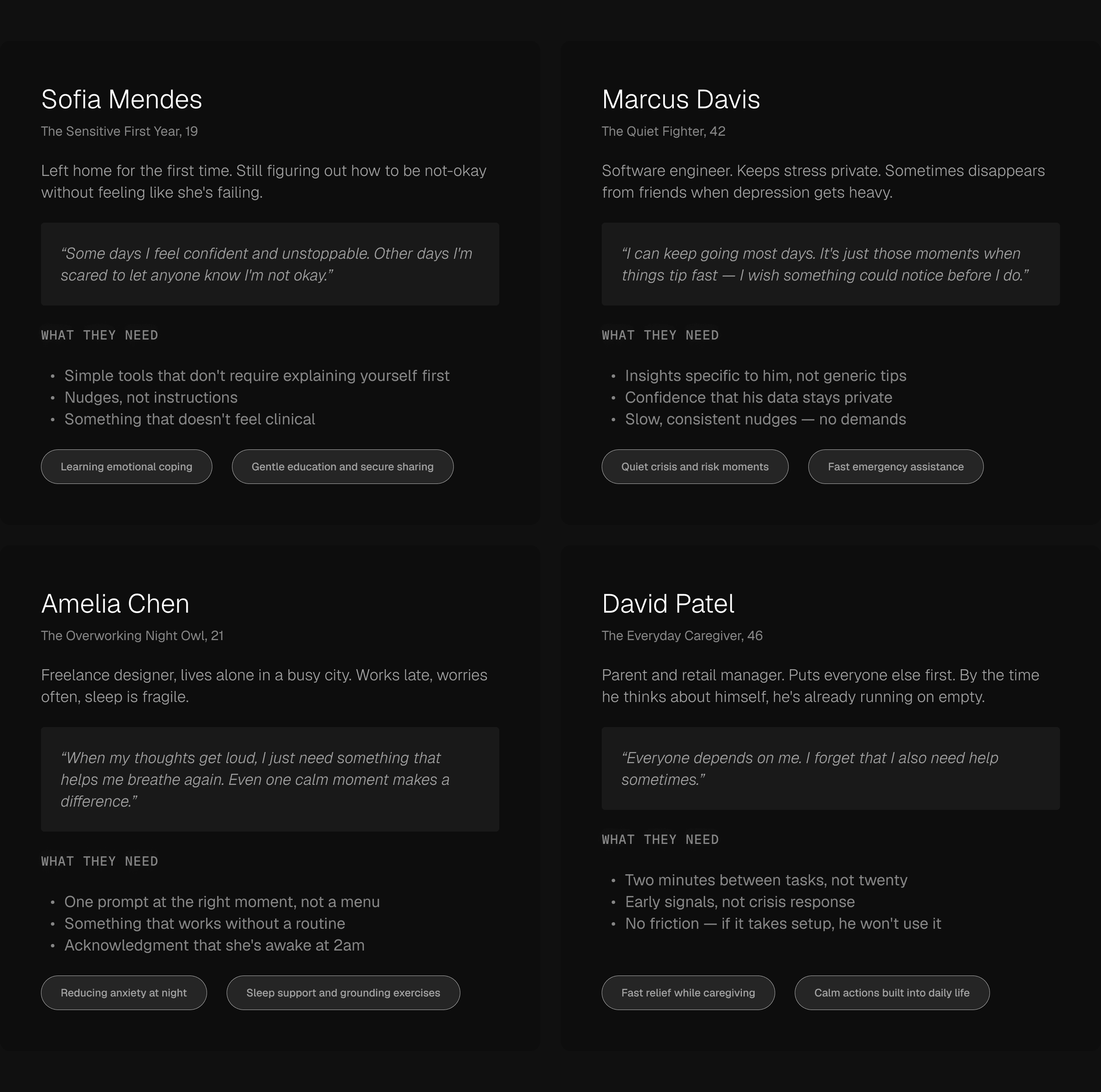
What Users Actually Need
Fourteen interviews. Five things that kept coming up.
The Loop of Care
How We Discovered It
Through interviews with high-stress professionals - product managers, engineers, caregivers - a consistent pattern emerged: stress is invisible until it's acute. Users open wellness apps at breaking points, not at prevention moments. This insight drove our entire approach: design for the gap before the crisis, not for the crisis itself.
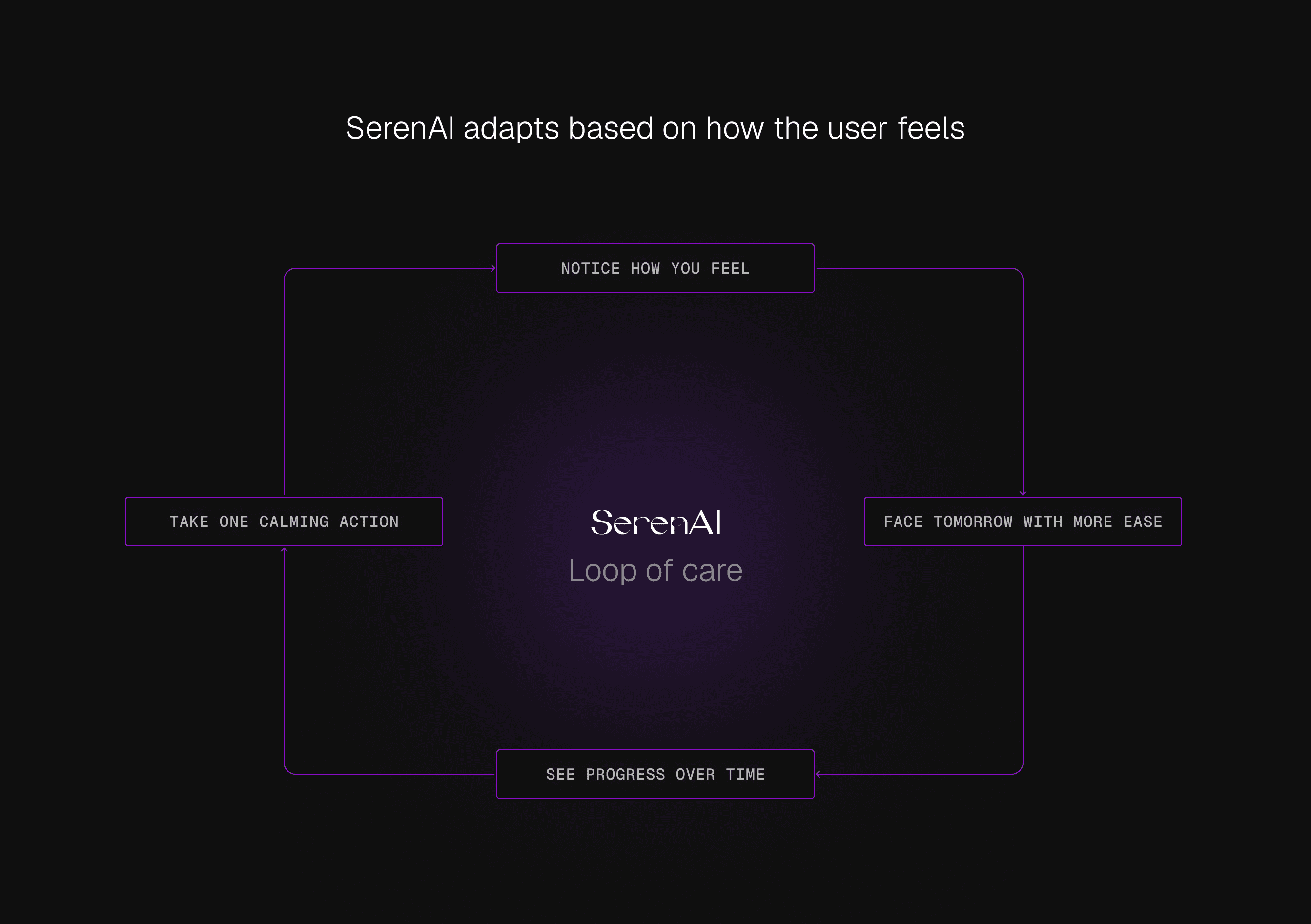
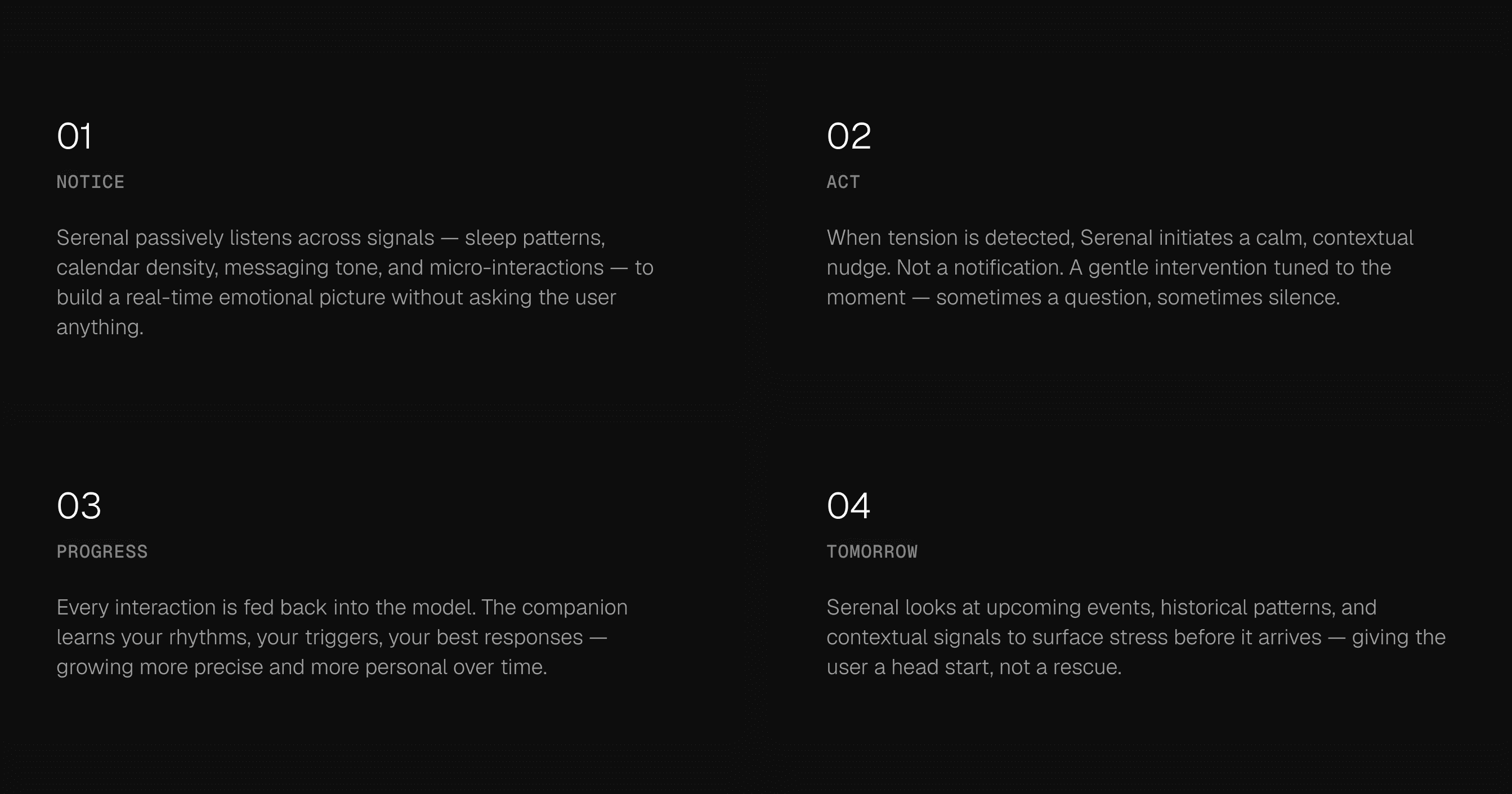
THE FOUR-STAGE CYCLE
That transforms passive data into proactive calm.
The Constraint That Forced Innovation
We wanted battery efficiency on Android. Constant background listening drains power. So we built a trigger-based system:
PASSIVE LISTENING → ACTIVE ONLY WHEN SIGNALS DIVERGE FROM BASELINE
This limitation became a feature. It forced us to be precise rather than always on. The system had to earn its interventions. That constraint made the product more trustworthy, not just more efficient.
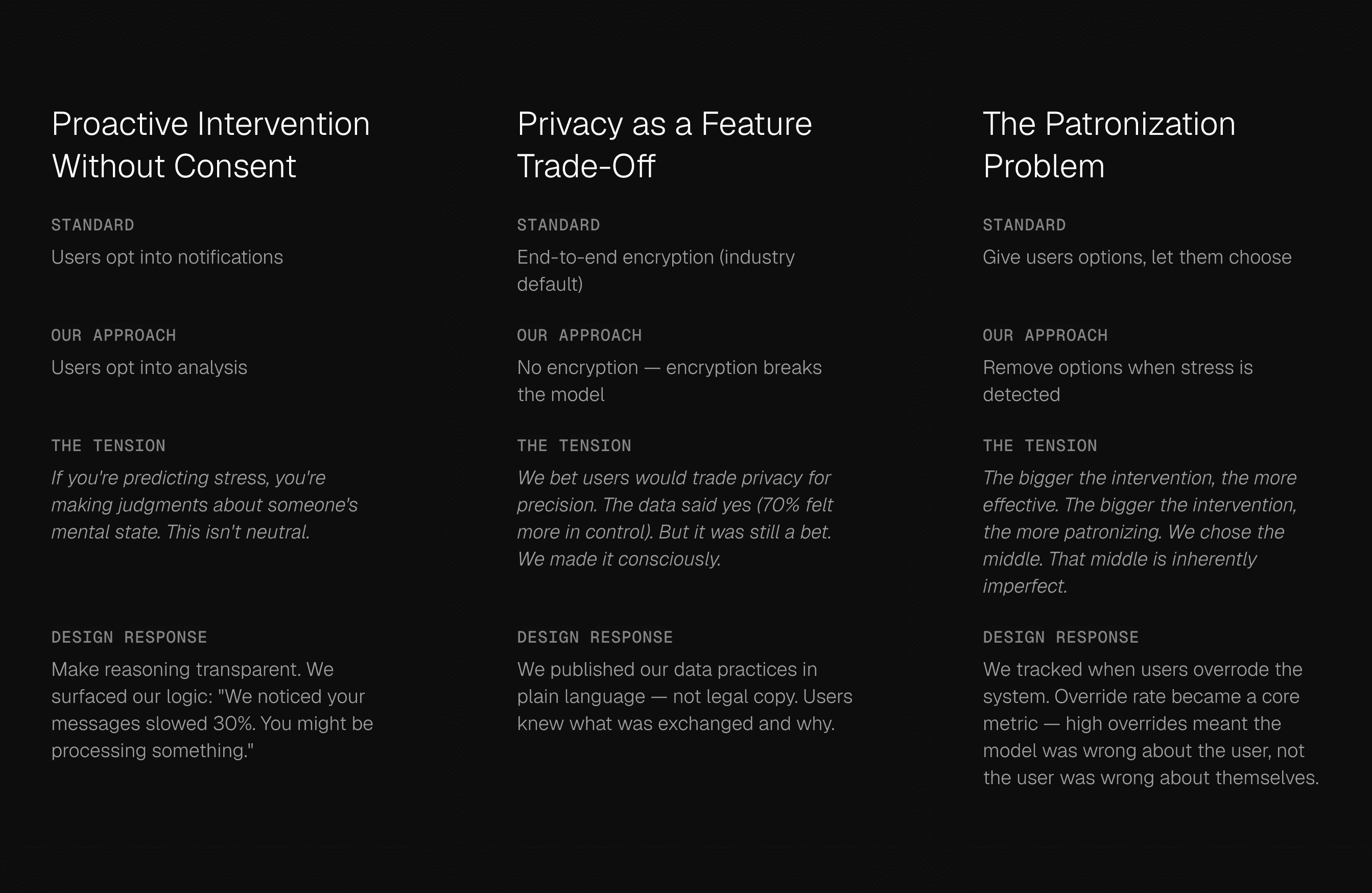
The Ethical Ground We Stand On
These aren't edge cases. They're the center of the project.
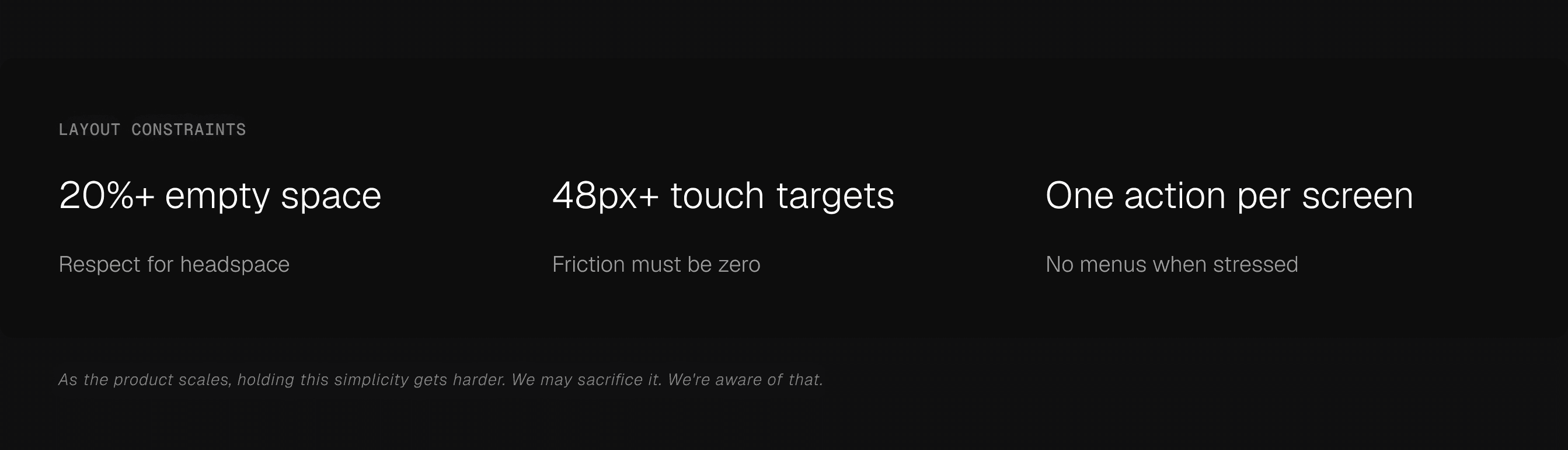
Layout constrains
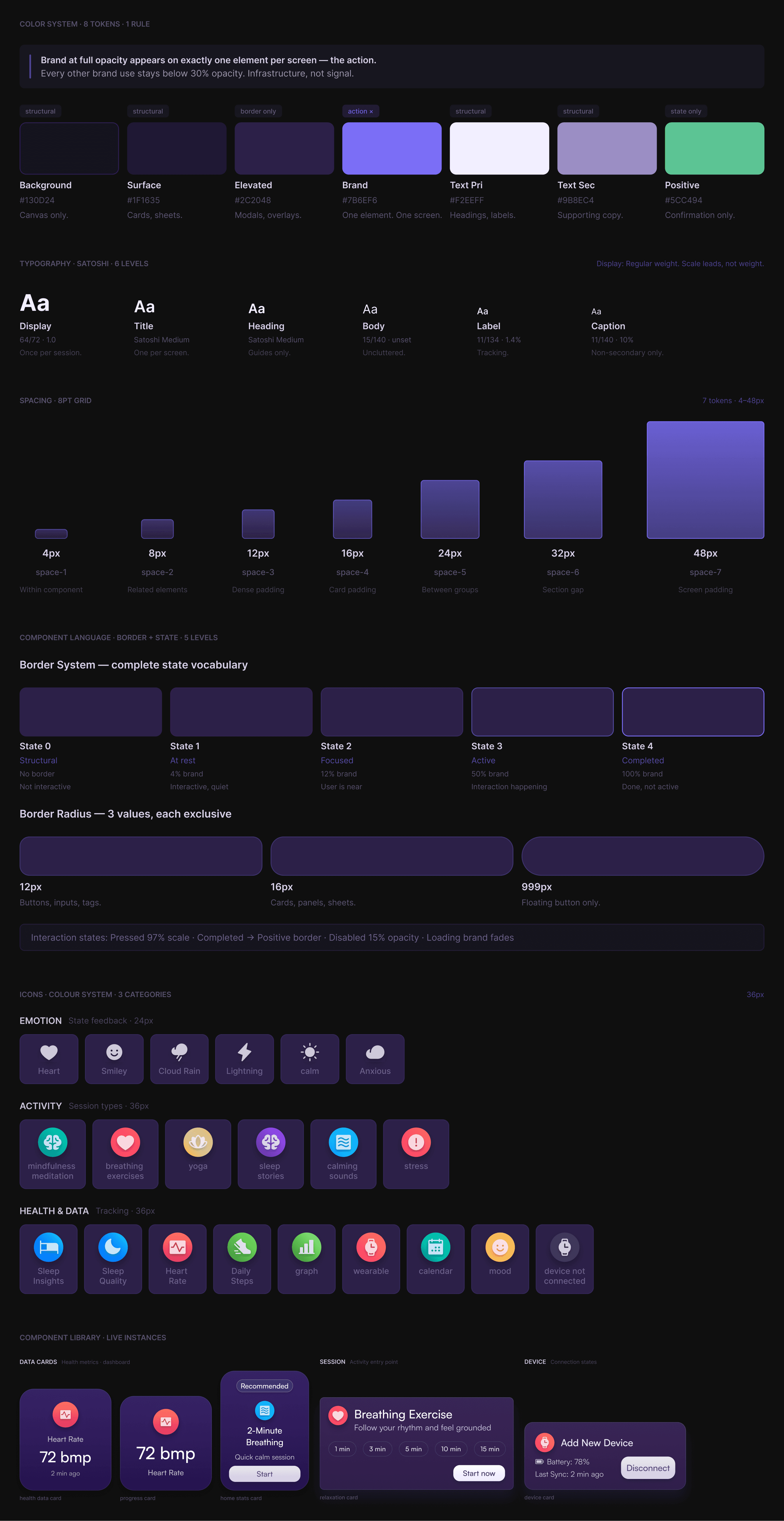
SerenAi Design Sytem
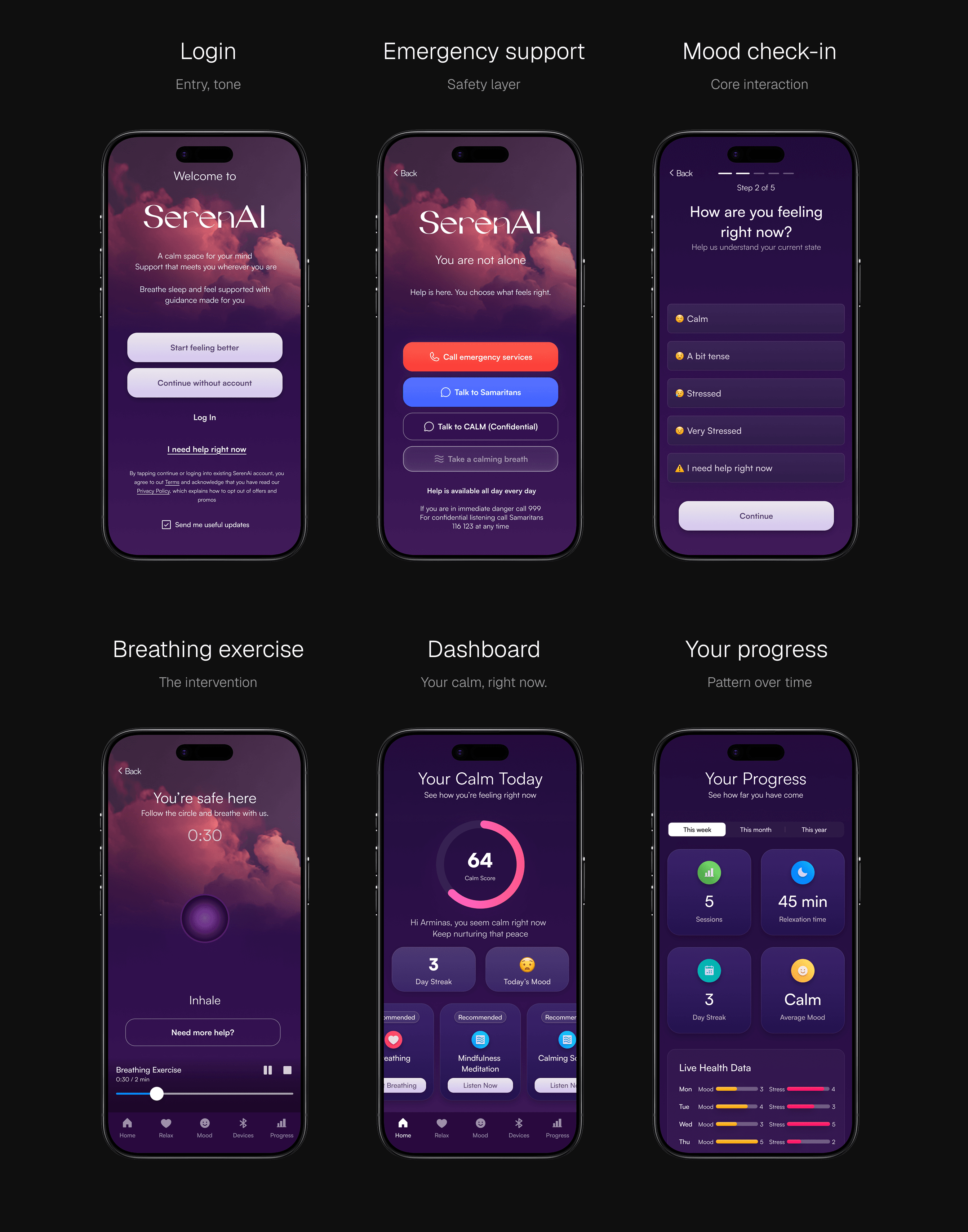
Final screens
Every screen started with one question: what is the minimum the user needs to see right now? These are the answers.
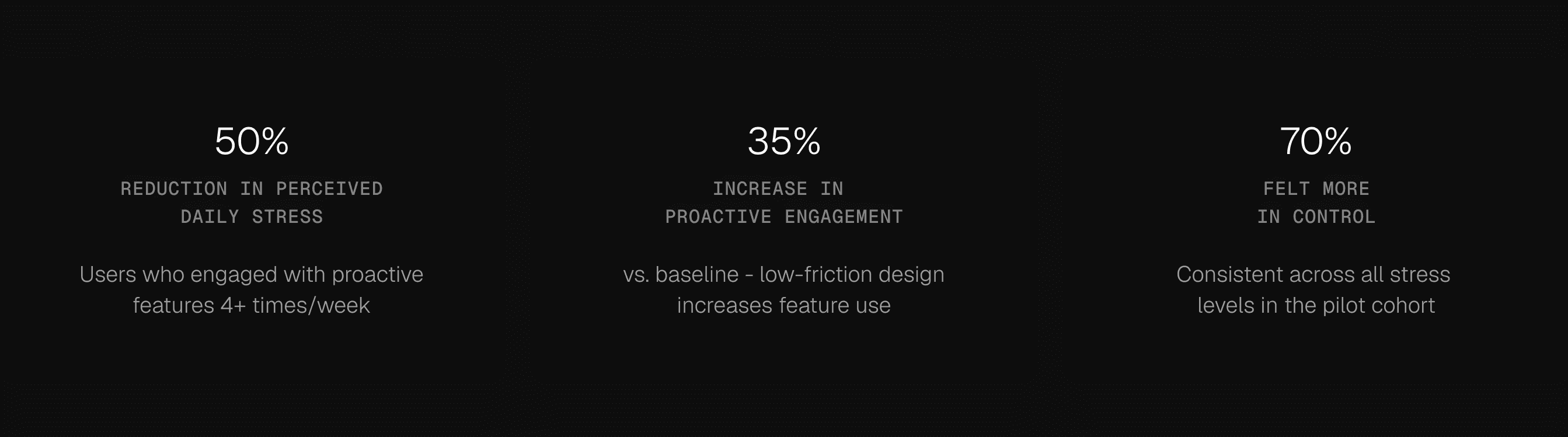
Validated Results: What the Data Actually Shows
Numbers from a 12-person pilot. Take them seriously, not literally.
WHAT THIS MEANS
Users prefer proactivity when it's done with restraint. The 4-week pilot (n=12) showed users catching stress signals an average of 10 minutes earlier than usual — before it became a crisis. That gap is where the behavioural change happens.
WHAT SURPRISED US
It wasn't the 50% reduction. It was that users started describing SerenaI as a relationship rather than an app.

That tension between creepy and caring - is where the product lives. We didn't resolve it. We designed for it.
What I'd Kill About This Product
IF I HAD TO CHOOSE, I'D KILL THE AI ENTIRELY.
Here's why: the AI is only powerful if you're willing to be monitored. Most people, if honest, aren't comfortable with that long-term. The pilot data looks good. The 12-month churn data doesn't exist yet.
The version of SerenaI that actually succeeds at scale is probably simpler:
Smart defaults - based on research, not ML
Explicit options - when you ask for help
Transparent reasoning - here's why we're suggesting this
No prediction - no constant analysis
The honest answer is that version is less interesting to build, and probably harder to sell. So we kept the AI. We kept the tension. And we design every day with one question:
“ARE WE HELPING OR CONTROLLING?”
I don't have the answer. I'm designing for the space where I don't have the answer. That's the real work.
What's Next
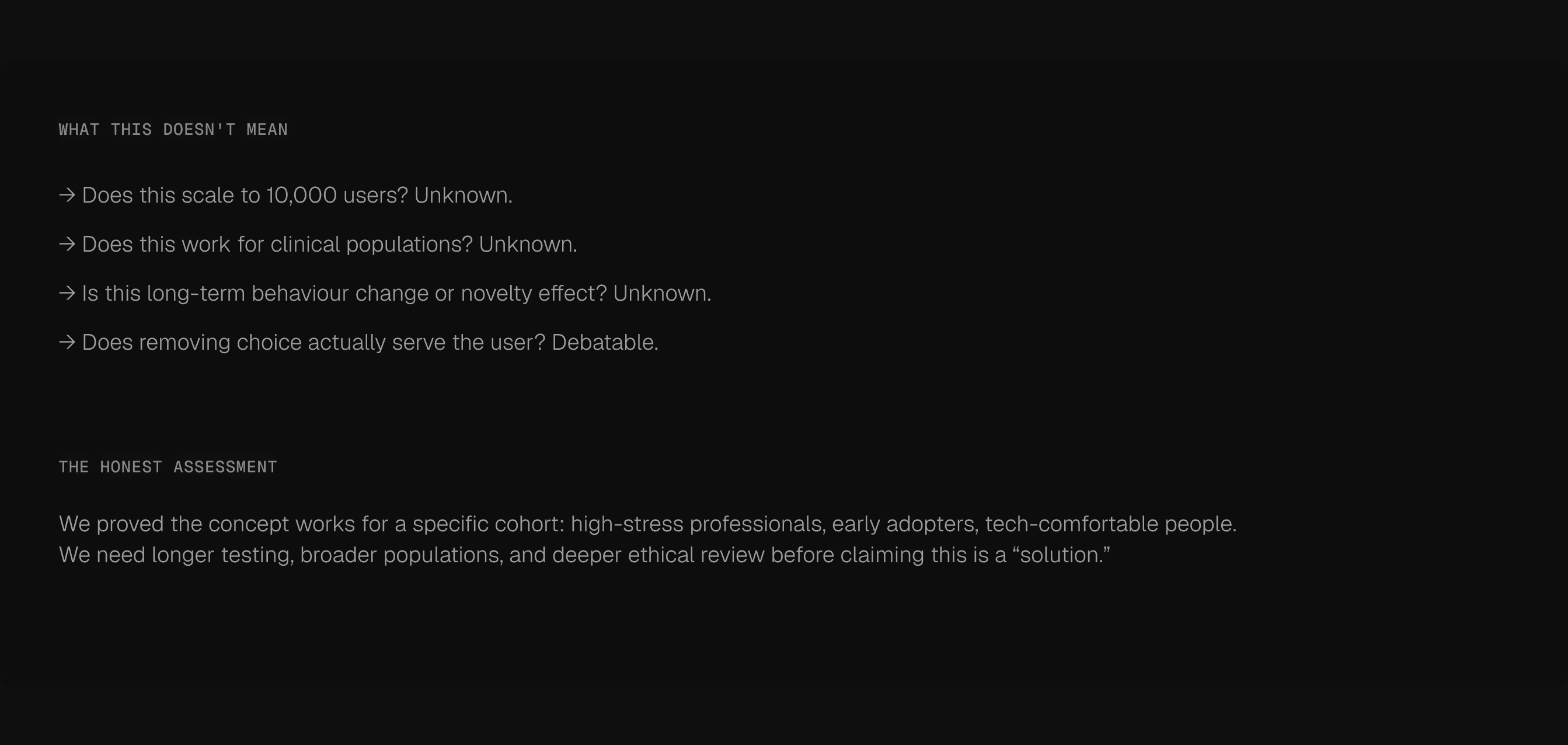
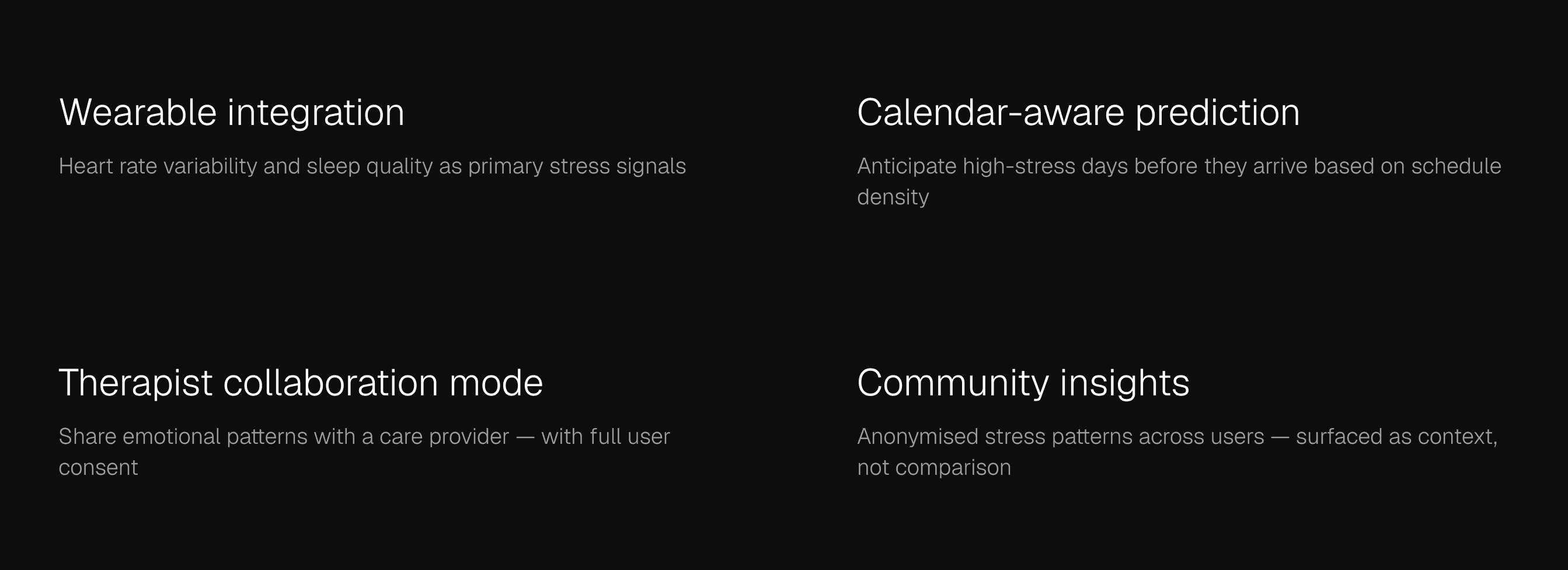
The pilot proved the concept. The next phase is richer data sources and more care contexts - starting with wearables and clinical collaboration.
Smooth Scroll
This will hide itself!
This will hide itself!
SerenaI - Care that doesn't ask you to care back
OVERVIEW
SerenaI is a proactive stress companion built on one uncomfortable hypothesis: the best mental health tool is one that doesn't wait to be asked. It reads signals like sleep, calendar density, and messaging patterns, then intervenes before the user hits a wall. The design challenge wasn't the interface. It was the timing, the consent, and the question of whether removing a user's choice is ever the right call.
YEAR
2025
ROLE
UI/UX Designer
Creative Director
SERVICES
User Experience Design
User Interface Design
AI Integration
Mental Health Research
UI Animation
About the project
Built on one hypothesis. Complicated by what proved it true.
We conducted 14 interviews with high-stress professionals. But the insight didn't come from asking “How do you want to manage stress?”
The insight came from watching them not use the apps they'd downloaded.
The Uncomfortable Truth We Started With
Many wellness tools make people feel worse during stress. They add too many choices and track progress in ways that feel judgmental. Users shared that they want emotional support that is compassionate and easy to access. They do not want more pressure when they are already struggling.
When stress is invisible it grows quickly. People need something that notices when they are not okay and responds with care.
That sat with us for a while. Then someone in the debrief said it out loud:
What if the best stress management tool is one that removes human agency?
Where We Got It Wrong First
What Users Actually Need
Fourteen interviews. Five things that kept coming up.
The Loop of Care
How We Discovered It
Through interviews with high-stress professionals - product managers, engineers, caregivers - a consistent pattern emerged: stress is invisible until it's acute. Users open wellness apps at breaking points, not at prevention moments. This insight drove our entire approach: design for the gap before the crisis, not for the crisis itself.
THE FOUR-STAGE CYCLE
That transforms passive data into proactive calm.
The Constraint That Forced Innovation
We wanted battery efficiency on Android. Constant background listening drains power. So we built a trigger-based system:
PASSIVE LISTENING → ACTIVE ONLY WHEN SIGNALS DIVERGE FROM BASELINE
This limitation became a feature. It forced us to be precise rather than always on. The system had to earn its interventions. That constraint made the product more trustworthy, not just more efficient.
The Ethical Ground We Stand On
These aren't edge cases. They're the center of the project.
Layout constrains
SerenAi Design Sytem
Final screens
Every screen started with one question: what is the minimum the user needs to see right now? These are the answers.
Validated Results: What the Data Actually Shows
Numbers from a 12-person pilot. Take them seriously, not literally.
WHAT THIS MEANS
Users prefer proactivity when it's done with restraint. The 4-week pilot (n=12) showed users catching stress signals an average of 10 minutes earlier than usual — before it became a crisis. That gap is where the behavioural change happens.
WHAT SURPRISED US
It wasn't the 50% reduction. It was that users started describing SerenaI as a relationship rather than an app.
That tension between creepy and caring - is where the product lives. We didn't resolve it. We designed for it.
What I'd Kill About This Product
IF I HAD TO CHOOSE, I'D KILL THE AI ENTIRELY.
Here's why: the AI is only powerful if you're willing to be monitored. Most people, if honest, aren't comfortable with that long-term. The pilot data looks good. The 12-month churn data doesn't exist yet.
The version of SerenaI that actually succeeds at scale is probably simpler:
Smart defaults - based on research, not ML
Explicit options - when you ask for help
Transparent reasoning - here's why we're suggesting this
No prediction - no constant analysis
The honest answer is that version is less interesting to build, and probably harder to sell. So we kept the AI. We kept the tension. And we design every day with one question:
“ARE WE HELPING OR CONTROLLING?”
I don't have the answer. I'm designing for the space where I don't have the answer. That's the real work.
What's Next
The pilot proved the concept. The next phase is richer data sources and more care contexts - starting with wearables and clinical collaboration.
Smooth Scroll
This will hide itself!
This will hide itself!
SerenaI - Care that doesn't ask you to care back
OVERVIEW
SerenaI is a proactive stress companion built on one uncomfortable hypothesis: the best mental health tool is one that doesn't wait to be asked. It reads signals like sleep, calendar density, and messaging patterns, then intervenes before the user hits a wall. The design challenge wasn't the interface. It was the timing, the consent, and the question of whether removing a user's choice is ever the right call.
YEAR
2025
ROLE
UI/UX Designer
Creative Director
SERVICES
User Experience Design
User Interface Design
AI Integration
Mental Health Research
UI Animation
About the project
Built on one hypothesis. Complicated by what proved it true.
We conducted 14 interviews with high-stress professionals. But the insight didn't come from asking “How do you want to manage stress?”
The insight came from watching them not use the apps they'd downloaded.
The Uncomfortable Truth We Started With
Many wellness tools make people feel worse during stress. They add too many choices and track progress in ways that feel judgmental. Users shared that they want emotional support that is compassionate and easy to access. They do not want more pressure when they are already struggling.
When stress is invisible it grows quickly. People need something that notices when they are not okay and responds with care.
That sat with us for a while. Then someone in the debrief said it out loud:
What if the best stress management tool is one that removes human agency?
Where We Got It Wrong First
What Users Actually Need
Fourteen interviews. Five things that kept coming up.
The Loop of Care
How We Discovered It
Through interviews with high-stress professionals - product managers, engineers, caregivers - a consistent pattern emerged: stress is invisible until it's acute. Users open wellness apps at breaking points, not at prevention moments. This insight drove our entire approach: design for the gap before the crisis, not for the crisis itself.
THE FOUR-STAGE CYCLE
That transforms passive data into proactive calm.
The Constraint That Forced Innovation
We wanted battery efficiency on Android. Constant background listening drains power. So we built a trigger-based system:
PASSIVE LISTENING → ACTIVE ONLY WHEN SIGNALS DIVERGE FROM BASELINE
This limitation became a feature. It forced us to be precise rather than always on. The system had to earn its interventions. That constraint made the product more trustworthy, not just more efficient.
The Ethical Ground We Stand On
These aren't edge cases. They're the center of the project.
Layout constrains
SerenAi Design Sytem
Final screens
Every screen started with one question: what is the minimum the user needs to see right now? These are the answers.
Validated Results: What the Data Actually Shows
Numbers from a 12-person pilot. Take them seriously, not literally.
WHAT THIS MEANS
Users prefer proactivity when it's done with restraint. The 4-week pilot (n=12) showed users catching stress signals an average of 10 minutes earlier than usual — before it became a crisis. That gap is where the behavioural change happens.
WHAT SURPRISED US
It wasn't the 50% reduction. It was that users started describing SerenaI as a relationship rather than an app.
That tension between creepy and caring - is where the product lives. We didn't resolve it. We designed for it.
What I'd Kill About This Product
IF I HAD TO CHOOSE, I'D KILL THE AI ENTIRELY.
Here's why: the AI is only powerful if you're willing to be monitored. Most people, if honest, aren't comfortable with that long-term. The pilot data looks good. The 12-month churn data doesn't exist yet.
The version of SerenaI that actually succeeds at scale is probably simpler:
Smart defaults - based on research, not ML
Explicit options - when you ask for help
Transparent reasoning - here's why we're suggesting this
No prediction - no constant analysis
The honest answer is that version is less interesting to build, and probably harder to sell. So we kept the AI. We kept the tension. And we design every day with one question:
“ARE WE HELPING OR CONTROLLING?”
I don't have the answer. I'm designing for the space where I don't have the answer. That's the real work.
What's Next
The pilot proved the concept. The next phase is richer data sources and more care contexts - starting with wearables and clinical collaboration.
Smooth Scroll
This will hide itself!
This will hide itself!